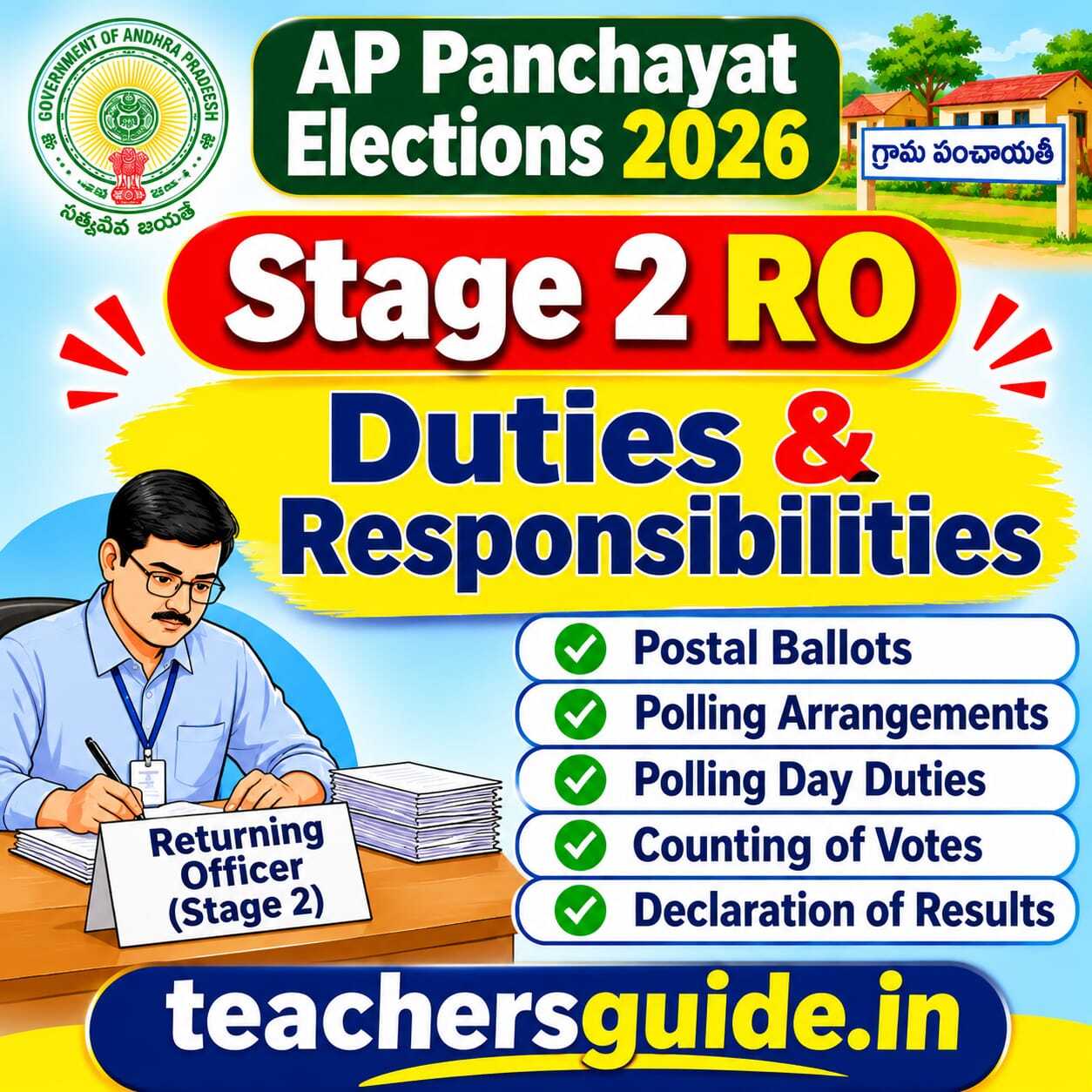
AP Panchayat Elections 2026
Stage 2 Returning Officers duties & responsibilities | The Andhra Pradesh Gram Panchayat Elections 2026 are being conducted to elect Sarpanches and Ward Members in villages across the state. Returning Officers (ROs) play an important role in ensuring that the election process is conducted in a free, fair, transparent and peaceful manner.
After completion of the initial nomination process by Stage 1 Returning Officers, Stage 2 Returning Officers are entrusted with important responsibilities relating to postal ballots, polling arrangements, conduct of polling, counting of voter and declaration of election results.
This article explains the important duties and responsibilities of Stage 2 Returning Officers based on the available RO Stage 2 Returning Officers based on the available RO Stage 2 training material.
1. Who is a Stage 2 Returning Officer?
A stage 2 Returning Officer is an authorised election officer responsible for conducting the subsequent stages of the Gram Panchayat election process.
The main responsibilities include:
- Processing and dispatching postal ballots.
- Inspecting Gram Panchayats and polling stations.
- Training polling personnel.
- Making polling arrangements.
- Supervising polling-day activities.
- Receiving and securing election materials.
- Counting votes.
- Declaring election results.
- Issuing election certificates.
- Conducting the Upa-Sarpanch election as per the prescribed procedure.
2. Postal Ballot – Important Duties of Stage 2 RO
Postal ballot arrangements are among the important responsibilities of the Returning Officer.
Who is eligible for a Postal Ballot?
According to the training material, the following categories of voters are eligible to vote through postal ballots, subject to applicable rules:
- Service voters and their eligible wives.
- Voters under preventive detention.
- Election-duty voters who are unable to vote at their assigned polling station because of election work.
Postal Ballot Papers Colours
The postal ballot papers for Gram Panchayat Elections have different colours.
| ELECTION | BALLOT PAPER COLOUR |
|---|---|
| SARPANCH ELECTION | PINK |
| WARD MEMBER ELECTION | WHITE |
The postal ballot papers contain election symbols allotted to candidates. Candidate names are not printed on these ballot papers.
Dispatch of Postal Ballots
The Returning Officer should dispatch postal ballots to eligible voters within 24 hours after the last date for withdrawal of candidature, as explained in the training material.
Important steps:
- Verify the marked electoral roll.
- Enter the voter’s part number and serial number on the postal ballot counterfoil.
- Separate the postal ballot paper.
- Mark PB against the voter’s name in the electoral roll.
- Prepare the required declaration and covers.
- Include the prescribed instructions for the voter.
- Dispatch the postal ballot through Certificate of Posting.
Important : The postal ballot serial number must be correctly entered in the relevant declaration and cover. A mismatch may result in rejection of the postal ballot.
Return and Safe Custody of Postal Ballots
The RO must receive postal ballot covers within the prescribed time.
- Keep received postal ballot covers safely.
- Maintain proper records.
- Keep late-received covers separately.
- Do not accept postal ballots received after the prescribed deadline.
- Preserve all postal ballot covers securely until counting begins.
Training and Inspection of Polling Stations
The Stage 2 RO should personally understand polling procedures before training the polling staff.
Important responsibilities:
- Attend the polling rehearsal conducted by the District Election Officer or Deputy District Election Officer.
- Visit the allotted Gram Panchayats.
- Inspect the polling stations.
- Identify any deficiencies in polling arrragements.
- Arrange training for Presiding Officers and Polling Officers.
- Conduct at least one polling rehearsal for the assigned polling personnel.
The objective is to ensure that every polling team understands its duties and responsibilities before election day.
Polling Arragements
The Returning Officer must make necessary arrangements for the smooth conduct of polling.
Polling Stations
The RO should obtain the list of polling stations from the Mandal Parishad Deevelopment Officer (MPDO).
Important duties:
- Verify the approved polling station list.
- Personally inspect polling station buildings.
- Check whether the building are suitable for polling.
- Report any conflict of interest involving the building owner and an election candidate or supporter to the District Election Officer.
- Ensure that necessary facilities are available.
Polling Personnel
The RO should coordinate the appointment and deployment of polling personnel.
The polling team generally consists of:
- Presiding Officer
- Polling Officer
- Other supporting polling personnel as assigned.
The RO must ensure that polling staff receive proper training and understand the prescribed polling procedure.
Polling Material Distribution
The RO must arrange for the distribution of polling materials to the respective polling teams.
Materials Include:
- Ballot papers
- Ballot boxes
- Electoral rolls
- Indelible ink
- Official seals
- Statutory and non-statutory covers.
- Prescribed forms and registers.
- Other election stationery.
Proper verification and distribution records should be maintained.
Duties of Stage 2 RO Polling Day
Polling Day is one of the most important stages of the election process.
The RO must supervise the polling process and ensure that polling takes place according to the election rules and instructions.
Commencement of Polling
The Returning Officer should ensure that polling stations are ready before the scheduled polling time.
Important responsibilities:
- Confirm the presence of polling personnel.
- Ensure that election materials have reached the polling stations.
- Ensure that polling begins at the prescribed time.
- Maintain communication with Presiding Officers.
- Attend to election-related issues reported by polling teams.
Identification of Voters
The identity of voters must be verified according to the prescribed procedure.
The polling staff should follow the approved identification documents and electoral roll instructions.
The RO should ensure that voter identification procedures are properly followed.
Prevention of Electoral Offences
The RO must take appropriate action in accordance with the election rules when electoral offences are reported.
Important offences include:
- Impersonation of voters
- Bribery of voters
- Undue influence
- Canvassing within the prohibited area
- Interference with the polling process
- Other offences specified under the applicable rules.
Compulsory Identification of Voters
The polling staff must verify the identity of voters using the identification documents permitted under the election instructions.
The training material lists several identification documents, including:
- Aadhar Card
- Voter ID Card (EPIC)
- Driving Licence
- Pan card
- Passport
- Other officially accepted identification documents.
The latest instructions issued by the State Election Commission should be followed.
Death of a Candidate Before Poll
If a candidate dies before polling, the Returning Officer must follow the procedure prescribed under the applicable election rules and instructions.
Adjournment of Poll
If circumstances arise that prevent the normal conduct of polling, the RO must follow the prescribed procedure for adjournment of poll.
Fresh Poll
A fresh poll may be required in circumstances specified under the election rules, including situations involving serious irregularities affecting the poll.
The RO must follow the directions of the competent election authority.
Allegations Against Polling Staff
If complaints or allegations are received against polling personnel, the RO should examine the matter and report or take action according to the applicable election instructions.
Receiving Polling Materials After Polling
After completion of polling, the Returning Officer must arrange for the safe receipt of election materials from polling stations.
Important responsibilities include:
- Receive ballot boxes and election materials.
- Verify the materials received from each polling station.
- Check the prescribed covers and documents.
- Verify the relevant polling records.
- Maintain proper receipt registers.
- Keep ballot boxes and election documents in safe custody.
- Make necessary arrangements for counting.
All election materials must be handled carefully to maintain the integrity of the election process.
Counting of Votes – Important Duties of Stage 2 RO
Counting is a crucial responsibility of the Returning Officer.
The RO must conduct the counting process according to the prescribed election rules.
Counting Arrangements
Before counting begins, the RO should:
- Arrange the counting centre.
- Ensure the availability of counting tables.
- Arrange counting personnel.
- Keep the required forms and registers ready.
- Verify the election materials.
- Ensure that authorised persons are permitted inside the counting area.
Counting of Ballot Papers
The Returning Officer must follow the prescribed counting procedure for Sarpanch and Ward Member elections.
According to the training material:
- Sarpanch ballot papers are pink.
- Ward Member ballot papers are white.
- Ballot papers must be examined according to the prescribed rules.
- Valid votes must be counted and recorded.
- Rejected ballot papers must be counted and recorded.
Grounds for Rejection of Ballot Papers
A ballot paper may be rejected on the grounds prescribed under the applicable election rules.
Examples include:
- No vote is recorded.
- Voters are marked in favour of more candidates than permitted.
- The ballot paper is spurious.
- The ballot paper is damaged or mutilated to such an extent that its identity cannot be established.
- The prescribed distinguishing mark is missing.
- The vote cannot be determined as valid under the rules.
The RO must record decisions regarding rejected ballot papers as required.
Recounting of Votes
If a candidate or election agent requests recounting, the Returning Officer must deal with the request according to the applicable rules.
The request should be considered in accordance with the prescribed procedure, and the decision must be properly recorded.
Equality of Votes (Tie)
If two or more candidates receive an equal number of valid votes, the Returning Officer must follow the tie-resolution procedure prescribed under the election rules.
The result must not be decided arbitrarily.
Declaration of Election Results
After completion of counting, the Returning Officer must declare the result according to the prescribed procedure.
Important duties:
- Verify the counting records.
- Finalise the valid votes obtained by each candidate.
- Prepare the result statement.
- Follow the prescribed procedure for determining the elected candidate.
- Announce the result.
- Complete the prescribed declaration form.
- Publish the result as required.
The result must be declared only after following all applicable election procedures.
Return of Election Records
After declaration of results, the Returning Officer must complete the prescribed election records and submit them to the competent authority.
Important records include:
- Counting statements.
- Ballot paper accounts.
- Result declaration forms.
- Election proceedings.
- Relevant statutory and non-statutory covers.
- Other prescribed election documents.
The RO should ensure that all records are properly completed and handed over as instructed.
Certificate of Election
After declaration of the result, the elected candidate should be issued the prescribed Certificate of Election.
The Returning Officer must:
- Verify the result.
- Complete the prescribed certificate.
- Enter the necessary particulars.
- Sign and issue the certificate according to the rules.
- Maintain the required record.
Preservation of Election Records
The Returning Officer must ensure the safe preservation and proper handling of election materials and records.
The prescribed statutory and non-statutory covers must be properly sealed and labelled.
The training material explains the use of different couloured covers, including:
- Pink Covers
- Green Covers
- Yellow Covers
- Blue Covers
The exact purpose and use of each cover should be followed according to the prescribed election instructions.
Election of Upa-Sarpanch
After the election of the Sarpanch and Ward Members, the election of the Upa-Sarpanch is another important responsibility covered in the Stage 2 training material.
Date, Time and Place
The meeting for the election of Upa-Sarpanch must be conducted according to the schedule and instructions issued by the competent authority.
Who Should Preside?
The meeting must be presided over by the officer authorised under the applicable Government Orders and election instructions.
The training material refers to G.O.Ms.No. 172 PR & RD (E&R) Department, dated 10.05.2006.
Record of Proceedings
The proceedings of the meeting must be recorded properly.
All prescribed procedures relating to the election must be followed.
Publication of Result
After completion of the election process, the result must be declared and published according to the prescribed procedure.
Important Responsibilities – Quick Revision
| S.No. | Responsibility | Main Work |
|---|---|---|
| 1 | Postal Ballots | Issue and receive postal ballots |
| 2 | Polling Stations | Inspection and arrangements |
| 3 | Polling Staff | Training and rehearsal |
| 4 | Polling Materials | Distribution and receipt |
| 5 | Polling Day | Supervision of polling |
| 6 | Election Offences | Follow prescibed actions |
| 7 | Ballot Boxes | Safe Custody |
| 8 | 1 | First Information |
| 9 | Counting | Counting of valid votes |
| 10 | Recounting | Deal with requests under rules |
| 11 | Declaration | Announce election results |
| 12 | Certificate | Issue Certificate of Election |
| 13 | Upa-Sarpanch | Conduct the prescribed election meeting |
Important Instructions for Stage 2 Returning Officers
Every Stage 2 RO should remember the following instructions:
- Follow the Andhra Pradesh Panchayat Raj election rules.
- Follow the latest State Election Commission instructions.
- Maintain impartiality and transparency.
- Ensure proper training of polling personnel.
- Inspect polling stations before election day.
- Ensure safe custody of ballot boxes and postal ballots.
- Maintain accurate election records.
- Follow the prescribed counting precedure.
- Record decisions relating to rejected votes and recounting.
- Declare results only after completing the prescribed procedure.
Conclusion
The Stage 2 RO plays a vital role in the successful completion of Gram Panchayat Elections 2026.
From postal ballot arrangements to polling station inspection, polling-day supervision, counting of votes and declaration of results, every responsibility requires careful attention and strict compliance with election rules.
All Returning Officers should thoroughly study the training material, attend election rehearsals and follow the latest instructions issued by the Andhra Pradesh State Election Commission and District Election Authority.
A responsible Returning Officer ensures a free, fair, peaceful and transparent election.
TeachersGuide.in – Your Complete Teachers Information Portal
Get the latest updates on AP Panchayat Elections 2026, teacher information, election duty instructions, government orders, examination materials and educational resources.
Share this article with all teachers and election duty officers.
DOWNLOAD RETURNING OFFICERS HAND BOOK